
How an independent healthcare provider streamlined their internal review process with AI.
We built a secure, HIPAA-compliant, AI-enabled review workflow that turns a compliance chore into operational intelligence.

An independent healthcare provider outgrew their internal review process.
23Peaks partnered with a growing healthcare provider to modernize their workforce's quarterly review process. With over 70 employees the company could no longer rely on paper worksheets, manual tracking, and scattered notes to keep up with growth.
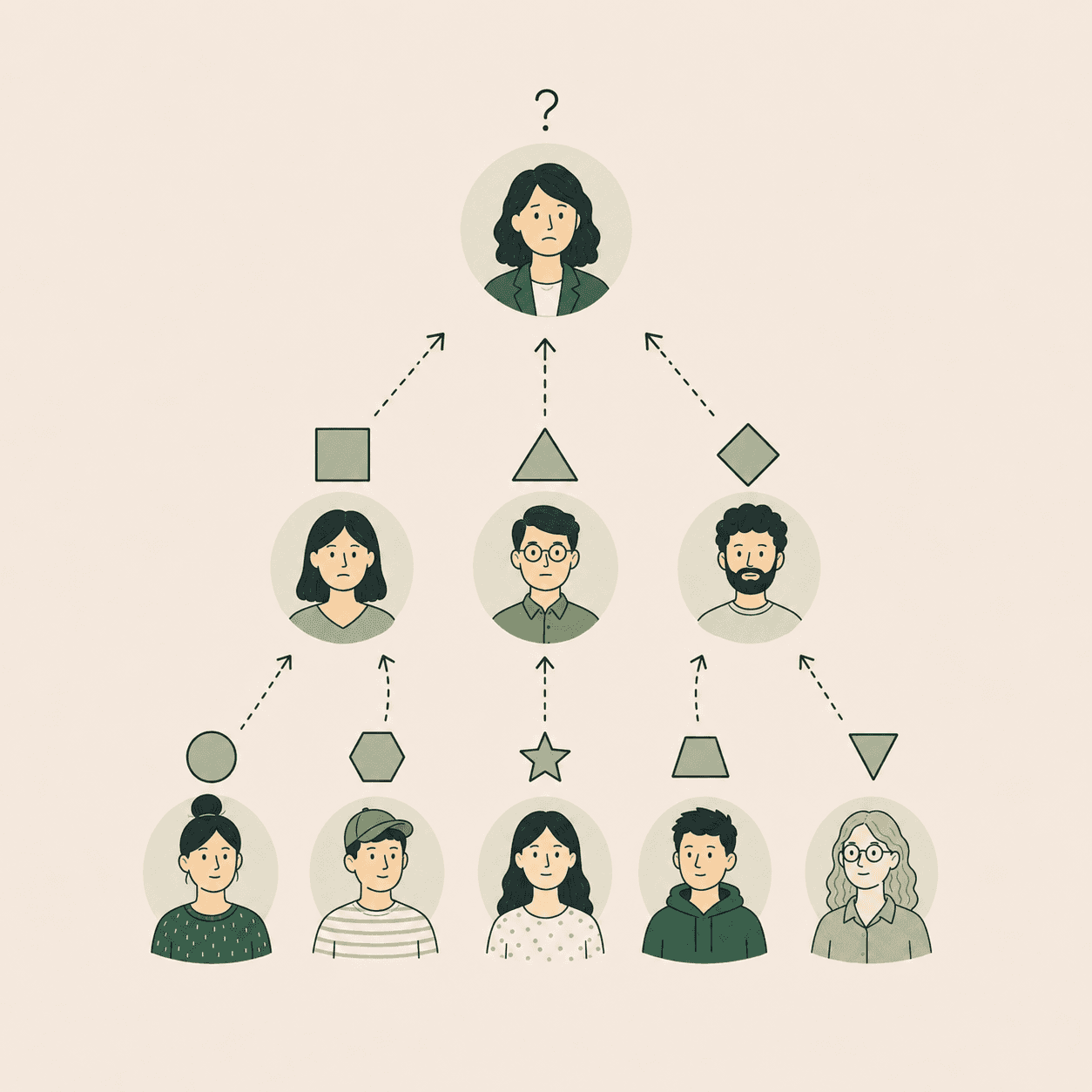
Reviews were happening. The business wasn't learning.
Quarterly reviews had become a manual compliance chore. Scheduling lived on a whiteboard. Reviews ran on paper. Completion was tracked in spreadsheets. Feedback disappeared into handwritten notes.
Senior staff spent ~37.5 hours per quarter managing the process, yet only 40% of reviews were completed on time.
Worse than the manual work – nothing connected employee feedback, manager observations, or leaderships sense of bottlenecks to team performance or the company's KPIs.
As a result, no one knew if KPIs were being met; managers weren’t equipped to mentor effectively; and employee feedback vanished into a file.
Senior time burned
Leadership and managers spent roughly a full workweek every cycle just coordinating a manual process.
Reviews slipped
Despite all that effort, fewer than half of reviews were finished on schedule each quarter.
Nothing connected
No feedback, observation, or note tied back to team performance or company KPIs — so insight vanished into a file.
The not-so-obvious solution.
The client considered two obvious paths: keep coordinating reviews manually inside Google Workspace, or buy a dedicated performance-management platform.
Neither solved the real problem.
A standalone HR platform would have added another system to license, maintain, and train staff on for a process that ran once per quarter. Plus, it would have forced their tiered review structure, sensitive note capture, and KPI reporting into a generic workflow.
They didn’t need a new HR system. They needed their existing review process to produce usable operating data.
Our approach: keep the tools staff already used, redesign the workflow, and add a lightweight software layer behind it.
A secure review system, built around the workflow.
We opened with an on-site working session. We sat with the executive team, the clinical director, the managers who run reviews, and the providers being reviewed to map the workflow before changing it.
From there we built a lightweight custom layer on Google Cloud that collects structured self-reviews, joins them with AI-generated notes, normalizes employee-manager relationships, maps themes to company KPIs, and generates role-specific reports. The front of the process stays in the client's existing Google Workspace — so staff had nothing new to learn, and review data stayed inside their HIPAA-compliant boundary.
Every employee completes a structured self-review before their cycle, so conversations start from real input instead of a blank page.
In-person and remote review conversations are captured with HIPAA-compliant tooling, keeping sensitive context inside the client's compliance boundary.
Scattered worksheets, spreadsheets, and handwritten notes are replaced by a single structured record of every review across the organization.
The system normalizes who reports to whom, so feedback rolls up cleanly through the tiered review structure instead of getting lost between levels.
Review themes are mapped to the company KPIs leadership sets, connecting individual feedback to organization-wide goals.
A lightweight pipeline on GCP joins self-reviews, AI-generated notes, and reporting relationships — no new tooling for staff to learn.
Employees, managers, leadership, executives, and the CEO each receive a tailored report shaped for their roles, feedback, and action items.
After each cycle, leadership gets a prioritized read on supervisory bandwidth, mentor-program gaps, role ambiguity, scheduling friction, and standardization.
A faster cycle — and a clearer view of the organization.
96% on-time completion
Up from roughly 40% in the prior quarterly cycle — measured by comparing completion against the previous quarter.
37.5 leadership hours / quarter
Roughly one full workweek of administrative burden removed from every cycle, in leadership and manager time alone.
Five role-specific reports
A single cycle now produces five report types — employee, manager, leadership, executive, and CEO — each contextualized to its reader.
KPIs across all ~70 staff
Leadership gained the organization-wide view the old process never produced — in a repeatable system the client owns outright.
Measurement note: on-time completion was compared against the prior quarterly cycle. Time savings were estimated from reduced scheduling coordination, note reconstruction, manual synthesis, and executive review preparation.
“This new process has transformed the way that we capture team reviews. Our executives are able to put down their pencils and be fully present. Additionally, nothing was lost. We were able to circle back and identify key wins and pinch points; refine, and charge intentionally towards our goals.”
Three choices made the difference.
Workflow redesigned first
AI note-capture and synthesis plugged into a clean process rather than automating a broken one. That is what it actually means to be an AI-native company.
Built on tools staff already used
Adoption without adaptation. The new process followed the existing quarterly rhythm instead of asking the organization to learn a platform.
Outputs built around decision-makers
No one-size-fits-all report. Each synthesis was tailored to the role — and to the individual in it — so every audience got what they needed to act on.